
Road to PACK EXPO International
Small parts don’t necessarily mean simple feeding applications.
Even a relatively straightforward plastic component has to move from random bulk supply to a defined orientation before it can be consistently presented to the next stage of automation. Part geometry, required orientation, feed rate, available space, and downstream requirements all influence how that process is approached.
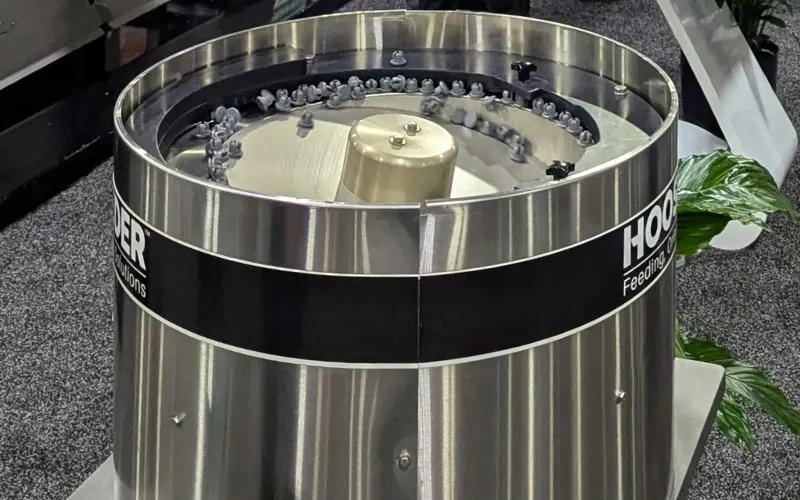
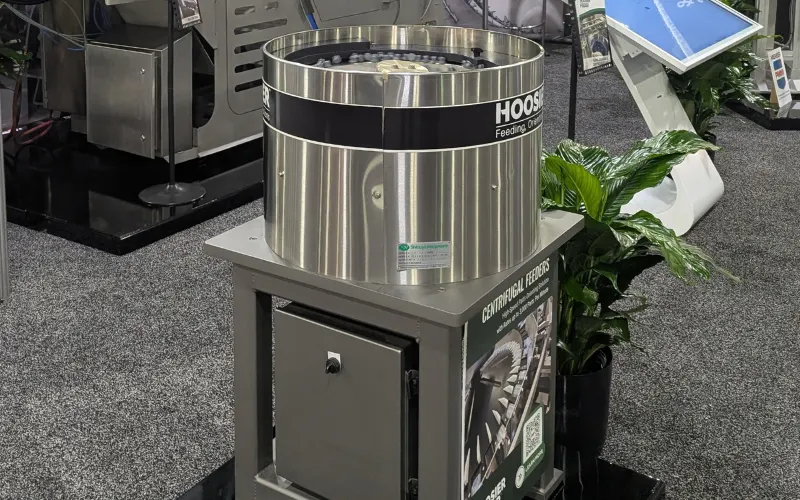
For our final Getting Oriented application before PACK EXPO International, we’re demonstrating that process with small plastic vial inserts running through a Mini Centrifugal Feeder.
The parts enter the feeder randomly oriented. Using a combination of centrifugal motion and mechanical tooling, the system singulates the inserts and establishes the required orientation: flange up, plug down. Selector cams identify parts that aren’t properly oriented and return them to the bowl for another pass.
The result is controlled, repeatable part presentation at rates of 300+ parts per minute (PPM).
Demo at a Glance
- Application: Small Plastic Part Feeding & Orientation
- Product: Plastic Vial Inserts
- Technology: Mini Centrifugal Feeder
- Industry: Packaging
- Demonstrates:
– Bulk part feeding
– High-speed singulation
– Mechanical part orientation
– Reprocessing of misoriented parts
– Consistent downstream presentation
– Compact centrifugal feeding - See It Live: PACK EXPO International | Booth N-5143
The Challenge of Feeding Small Plastic Parts
When parts are supplied in bulk, they enter the feeding process in random positions. Before downstream automation can reliably receive them, the feeder has to create order from that randomness.
For these plastic vial inserts, that means more than separating one part from another. Each insert needs to reach the discharge in a specific position with the flange facing up and the plug facing down.
At the same time, the application is running at more than 300 PPM.
That combination of small part size, defined orientation, and production speed makes controlled part handling important throughout the feeding process.
It also illustrates why feeder selection isn’t based on part size alone. Engineers need to consider how a part behaves in bulk, how it can be mechanically oriented, the required feed rate, available equipment footprint, and how it needs to be presented downstream.
How Does a Mini Centrifugal Feeder Orient Parts?
The vial inserts begin in bulk supply without a consistent orientation.
As the parts move through the Mini Centrifugal Feeder, centrifugal motion creates controlled part flow while mechanical cams and tooling establish the required orientation.
For this application, the process can be simplified into:
Bulk Parts
Singulation
Orienting Cams & Tooling
Selector Cams
Flange Up / Plug Down
Misoriented
Discharge
Return to Bowl / Reprocess
H
The important part of that sequence is what happens when a part isn’t correctly oriented.
Orienting the Part
Mechanical cams and tooling interact with the geometry of the vial insert as it travels through the feeder.
These features are designed around the part and the required final presentation, gradually bringing acceptable parts into the flange-up, plug-down orientation needed at discharge.
What Happens to a Misoriented Part?
Not every part will reach the selector in the correct position on its first attempt.
Rather than allowing an incorrectly oriented insert to continue toward discharge, selector cams return the misoriented part to the bowl for reprocessing.
The part then moves through the feeding process again and has another opportunity to reach the required orientation.
This select-and-return process helps maintain consistent presentation without requiring every randomly loaded part to achieve the correct orientation on its first pass.
Engineering Insight
Orientation isn’t only about getting a part into the correct position. The feeding system also needs a way to prevent incorrectly oriented parts from continuing downstream.
From Orientation to Downstream Automation
Once the vial inserts have passed the selector cams in the correct orientation, they continue onto a short discharge running surface.
For the PACK EXPO demonstration, the parts aren’t being transferred into another production machine. Instead, the discharge section demonstrates how properly oriented parts would leave the feeder and be presented to the next stage of automation.
The parts are then returned to the bowl so the demonstration can run continuously throughout the show.
In a production application, the downstream interface would be engineered around the requirements of the complete automation process.
This is an important distinction when evaluating a feeder. Getting a part oriented is only part of the application. How that orientation is maintained and how the part is presented at discharge also need to match what happens next.
Why Use a Mini Centrifugal Feeder?
The operating principle is similar to larger centrifugal feeding systems, but the Mini Centrifugal provides a more compact option for smaller components.
Hoosier Feeder’s Mini Centrifugal Feeder is designed for high-speed orientation of smaller parts while maintaining a compact footprint for integration into automated equipment.
For this application, the size of the vial inserts and the opportunity to conserve equipment space made the Mini Centrifugal a good fit.
At more than 300 PPM, the system also demonstrates that a smaller feeder footprint doesn’t necessarily mean a low-rate feeding process.
The appropriate feeder size ultimately depends on the application, including:
- Part size and geometry
- Required orientation
- Target feed rate
- Available equipment space
- Discharge requirements
- Downstream automation
The goal isn’t simply to use the smallest feeder possible. It’s to size and configure the feeding system around what the part and process actually require.
Mini vs. Full-Size Centrifugal Feeding
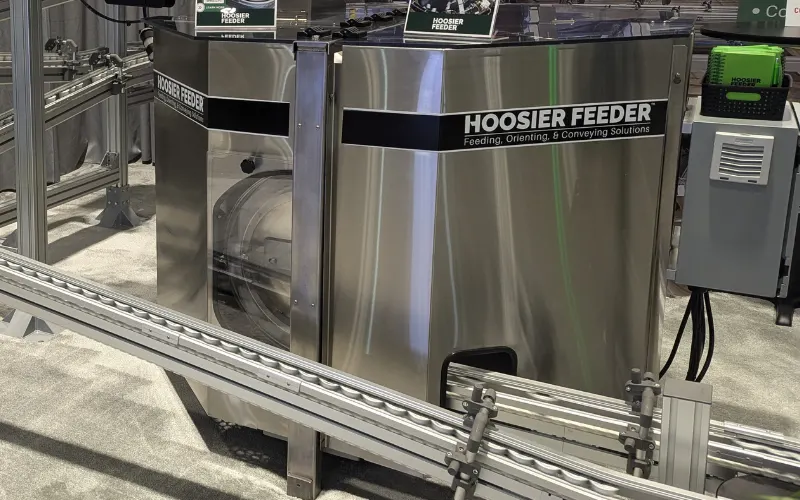
Visitors to our PACK EXPO booth will have a useful opportunity to see two centrifugal feeding applications running in the same space.
Our Mini Centrifugal Feeder will be running small plastic vial inserts, while a larger centrifugal feeder system will be orienting coffee pods before transferring them onto an alpine conveyor.
Both applications use centrifugal feeding technology, but they aren’t identical systems solving identical problems.
The coffee pod application demonstrates orientation followed by continuous product transfer through a larger packaging system. The vial insert application demonstrates high-speed orientation of a much smaller plastic component within a compact feeder footprint.
Seeing the two applications together helps illustrate an important part of feeder selection: the technology may be similar, but the system still needs to be engineered around the product and process.
Small Parts, Application-Specific Tooling
The vial inserts are one example of what a Mini Centrifugal Feeder can handle. The broader takeaway is how centrifugal feeding can be adapted for smaller components that require high-speed, consistent orientation.
Part geometry plays a major role in that process.
The orienting and selector tooling used for one component isn’t automatically the right solution for another. A different part may have a different center of gravity, geometry, orientation requirement, feed rate, or downstream presentation.
That’s why evaluating a small-part feeding application starts with the part.
Understanding how it behaves in bulk, which features can be used to establish orientation, and what the next stage of automation needs to receive helps determine the appropriate feeder size, tooling, and discharge approach.
See the Mini Centrifugal Feeder at PACK EXPO International
At PACK EXPO International, you’ll be able to watch the entire process in Booth N-5143.
Start with the randomly loaded vial inserts and follow them through the Mini Centrifugal Feeder. Watch the orienting tooling establish the flange-up, plug-down position. Look for the selector cams returning incorrectly oriented parts to the bowl. Then watch correctly oriented parts continue onto the discharge surface.
The application is one of four systems we’ll have running live, each demonstrating a different approach to feeding, orienting, inspecting, or presenting products for downstream automation.
If you’re working with a small component of your own, bring it with you. Our team can discuss the part geometry, required orientation, production rate, available footprint, discharge requirements, and downstream process with you at the show.
Now that you’re a little more oriented before the show, you’ll know exactly what to watch for when the Mini Centrifugal is running.
PACK EXPO International 2026
📅 October 18–21 | Chicago
📍 Hoosier Feeder | Booth N-5143
🎟️ Complimentary Registration Code: 15Y01