
Blow Feed Mechanisms: Transferring Oriented Parts to Downstream Automation
Moving an oriented part from a feeder to the next stage of automation isn’t always as simple as placing it on a conveyor. Sometimes the next operation is several feet away, positioned at a different elevation, or located where traditional conveyor or mechanical transfer methods aren’t practical.
That’s where a blow feed mechanism becomes an effective solution.
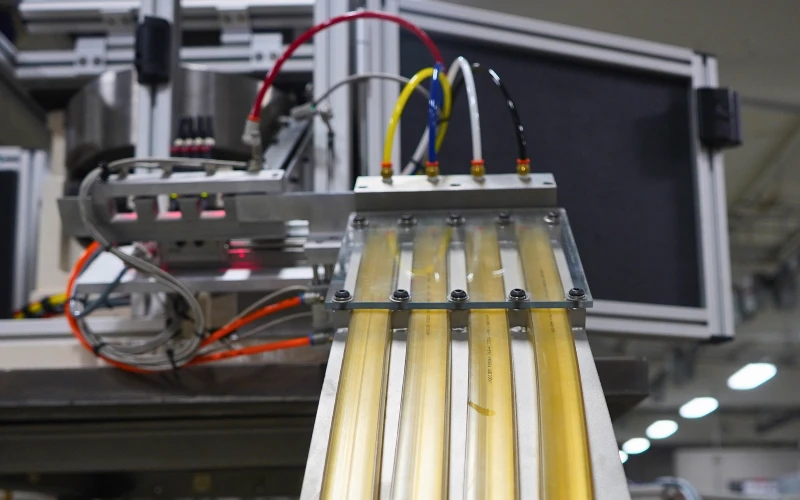
Using precisely controlled air pulses, blow feed systems transfer individual parts through tubing while maintaining their orientation. This allows manufacturers to reliably deliver parts to robotic placement systems, end-of-arm tooling, automated assembly equipment, and other downstream automation without the need for additional mechanical transfer devices.
How Does a Blow Feed Mechanism Work?
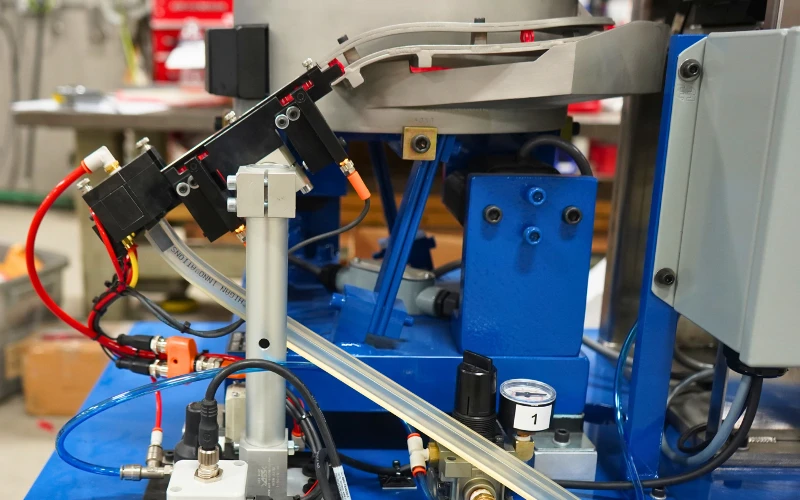
Once a part has been properly oriented and released from the feeder, a controlled burst of compressed air propels it through specially sized tubing toward the next operation.
Because the part is already oriented before entering the tube, the blow feed system is designed to maintain that orientation throughout the transfer process. The result is reliable part presentation at the destination, even when the next operation is located several feet away or requires a different machine layout.
Blow feed mechanisms are commonly integrated with vibratory feeder systems, robotic placement systems, end-of-arm tooling, and other automated assembly equipment to create a seamless transition from bulk part feeding to automated assembly or placement. This helps maintain part orientation from the feeder all the way to the point of use.
When Is a Blow Feed the Right Solution?
Blow feed mechanisms are ideal when an oriented part needs to be transferred beyond the feeder while maintaining its presentation for the next stage of automation.
Common Blow Feed Applications:
- Transferring parts over longer distances
- Delivering parts to robotic placement systems
- Feeding parts to end-of-arm tooling (EOAT)
- Delivering parts to equipment at different elevations
- Maintaining part orientation during transfer
- Eliminating the need for additional mechanical transfer equipment
Because every manufacturing application is different, the tubing diameter, air pressure, transfer distance, and overall system design are engineered around the specific part and production requirements.
Benefits of Blow Feed Mechanisms
When properly engineered for the application, blow feed systems provide several advantages.
Advantages of Blow Feed Mechanisms:
- Smooth, efficient part transfer using controlled air pulses
- Reliable part orientation throughout the transfer process
- Elimination of additional mechanical transfer equipment
- Flexible equipment layouts
- Seamless integration with vibratory feeders, robotic placement systems, and end-of-arm tooling
- Compact, efficient automation cells

Custom Blow Feed Systems from Hoosier Feeder
No two applications are exactly alike. Part size, weight, geometry, transfer distance, required orientation, and downstream automation all influence how a blow feed system should be designed.
At Hoosier Feeder, our engineers develop complete feeding and part handling solutions that integrate feeders, blow feed mechanisms, robotic placement systems, end-of-arm tooling, and downstream automation into one reliable, repeatable system. Every solution is engineered around your specific part, process, and manufacturing goals to deliver consistent performance throughout the automation process.
Watch the Blow Feed Mechanism in Action
Seeing a blow feed mechanism operate makes it easier to understand how controlled air transfer can simplify automation layouts while maintaining consistent part orientation.
Watch our latest Mechanism Spotlight video to see how blow feed systems transfer oriented parts efficiently from the feeder to robotic placement systems, end-of-arm tooling, and other downstream automation processes.
If you’re evaluating a new automation project or looking for a more efficient way to transfer parts while maintaining orientation, our engineering team is ready to help. Contact Hoosier Feeder to discuss your application and determine whether a custom blow feed system is the right solution for your automation process.